
Cryptographic key management is the set of processes that protects, controls, and manages the lifecycle of the keys used in data and transaction encryption.
For financial institutions, efficient management is essential to ensuring security, regulatory compliance, and operational continuity.
In this article, you'll learn how key management works, the difference between Vault, HSM, and KMS, and how to protect cryptographic assets in critical environments.
The security of cryptography depends on the protection of the keys
Financial institutions use cryptography to secure transactions, authenticate users, sign digital documents, and ensure the confidentiality of information.
However, the effectiveness of these mechanisms depends on the protection of the cryptographic assets used by the applications. If a cryptographic key is compromised, even robust algorithms fail to provide the expected security.
As a result, protecting and managing these assets has become a priority for organizations operating in critical and regulated environments.
What are crypto assets?
Cryptographic assets are pieces of information used to secure systems and control sensitive operations.
Some of the main examples include:
- Cryptographic keys;
- Digital certificates;
- Authentication tokens;
- API credentials;
- Technical terms;
- Database credentials.
These assets must remain protected throughout their entire lifecycle, as any compromise could result in fraud, service outages, and regulatory compliance failures.
What is cryptographic key management?
Key management encompasses the processes and technologies responsible for managing the entire lifecycle of the keys used by applications.
This includes:
- Generation;
- Custody;
- Distribution;
- Usage;
- Rotation;
- Repeal;
- Audit.
An effective strategy reduces operational risks, enhances security, and makes it easier to comply with regulatory requirements.
Custody and management: What's the difference?
Although they often appear together, custody and management are distinct functions.
Custody protects crypto assets from unauthorized access.
Management oversees the entire lifecycle of these assets, establishing policies for their use, access control, auditing, and rotation.
This distinction is essential to understanding the role of each technology.
Vault, HSM, and KMS: Understanding the Role of Each
Vault
A Vault is a secure repository used to store cryptographic assets, such as keys, certificates, tokens, and credentials.
It can be implemented in software or hardware, depending on the organization's security requirements.
HSM
A Hardware Security Module (HSM) is a device designed to protect cryptographic keys and perform cryptographic operations in a highly secure environment.
It is widely used when there are strict security and compliance requirements.
KMS
The Key Management System (KMS) manages the lifecycle of cryptographic keys.
It manages processes such as key generation, distribution, rotation, revocation, auditing, and access policies, regardless of where the keys are stored.
The Lifecycle of Cryptographic Keys
A management strategy covers every stage of the keys' lifecycle.
Generation
Keys must be generated in trusted environments using secure algorithms and randomization mechanisms.
Custody
After they are created, they must be stored in vaults, HSMs, or other specialized solutions that prevent unauthorized access.
Distribution and Use
Keys must be made available only to authorized applications, always through secure channels and in accordance with security policies.
Rotation and Revocation
Periodic replacement reduces exposure risks. When a key is no longer needed or shows signs of compromise, it must be revoked and securely disposed of.
Key Challenges Facing Financial Institutions
Digital transformation has significantly increased the amount of crypto assets managed by organizations.
In addition to protecting this information, financial institutions must ensure:
- Compliance with regulatory requirements;
- High service availability;
- Traceability of operations;
- Protection in hybrid and multicloud environments;
- Control over thousands of keys and credentials distributed across different applications.
Without a centralized strategy, these challenges increase the risk of security incidents and heighten operational complexity.
How PRODIST Supports the Protection of Crypto Assets
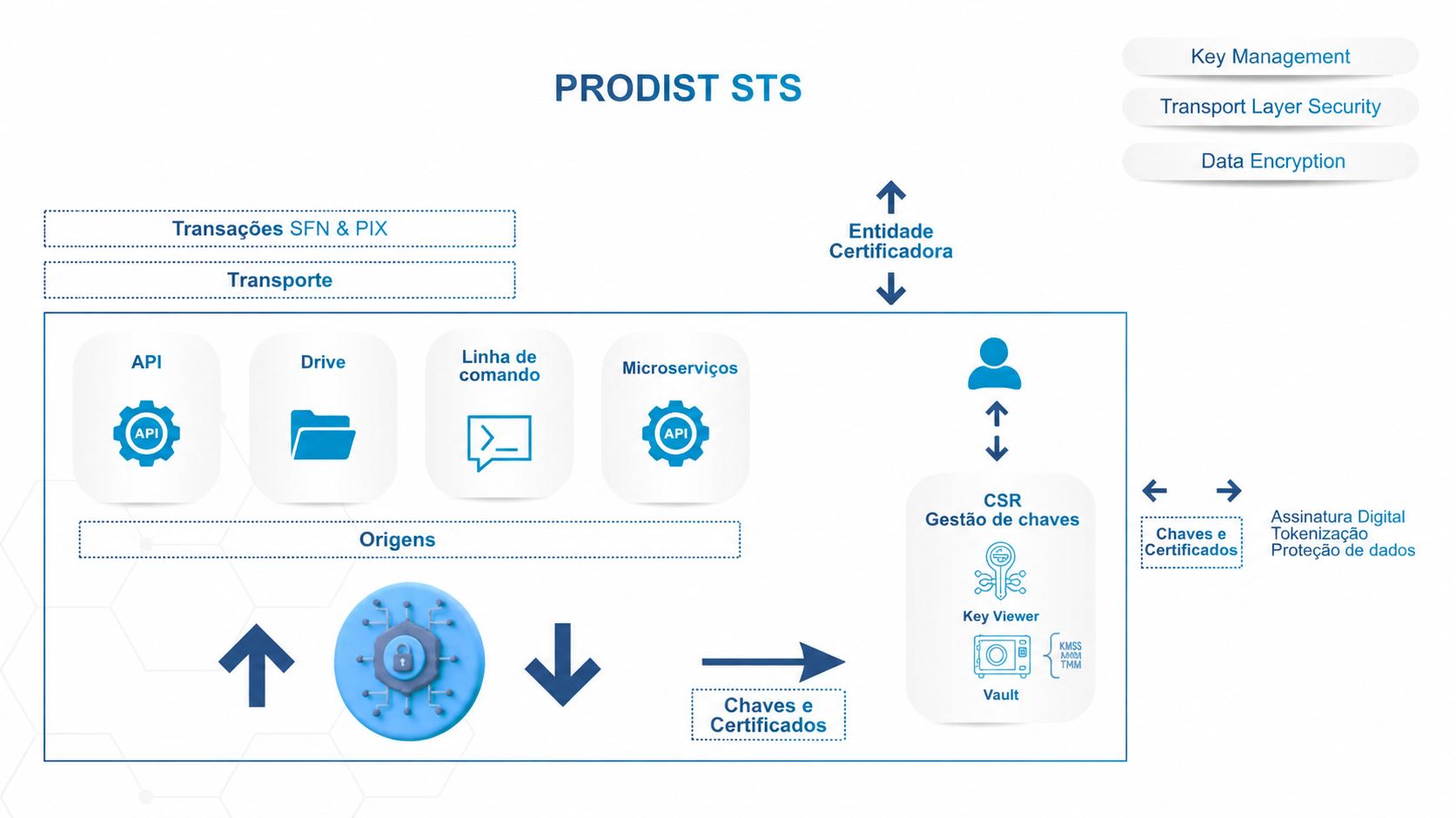
PRODIST STS was developed to meet the security needs of financial institutions, offering an integrated platform for encryption, digital signatures, and cryptographic asset management.
The solution enables centralized management of the key lifecycle, secure cryptographic operations, and integration with the leading custody mechanisms used in the market.
Among its key features are:
- Centralized management of cryptographic keys;
- Custody in a proprietary software-based vault;
- Integration with certified HSMs;
- Integration with cloud-based key management services;
- Encryption and digital signatures;
- mTLS authentication;
- Role-Based Access Control (RBAC);
- Integration via components, file systems, or microservices using OAuth2;
- Support for on-premises, hybrid, and cloud environments.
The platform meets the requirements of various systems operated by the Central Bank, NÚCLEA, Pix, and SPED e-Financeira, enabling organizations to strengthen their security without altering their existing architecture.
You can count on PRODIST
Protecting crypto assets has become an essential component of financial institutions' security strategies.
More than just storing keys, it is necessary to manage their entire lifecycle, ensuring control, traceability, and regulatory compliance.
By combining key management, secure custody, and integration with various technologies, organizations reduce operational risks and increase confidence in their critical processes.
With nearly four decades of experience in the financial market, PRODIST offers technology, expertise, and specialized support to help institutions securely and reliably protect their crypto assets.
In addition to its technology, PRODIST offers a competitive advantage recognized by the market: specialized technical support, prompt service, and close monitoring of its clients’ operations.
If your institution is looking to strengthen data security, meet the Central Bank’s regulatory requirements, and ensure the proper protection of crypto assets, having a robust key management strategy is a crucial step!
FAQ – Cryptographic Key Management
It is the set of processes responsible for managing the lifecycle of cryptographic keys, from their generation to their revocation.
Vault provides custody of crypto assets, HSM provides this custody using specialized hardware, and KMS manages the key lifecycle.
No. In addition to keys, a Vault can store digital certificates, tokens, technical passwords, API credentials, and other cryptographic assets.
HSM is recommended for environments that require enhanced protection, secure execution of cryptographic operations, and compliance with specific regulatory requirements.
Not necessarily. PRODIST STS can use its own software-based Vault or integrate with certified HSMs and cloud-based key management services, allowing each organization to adopt the architecture that best suits its needs.